
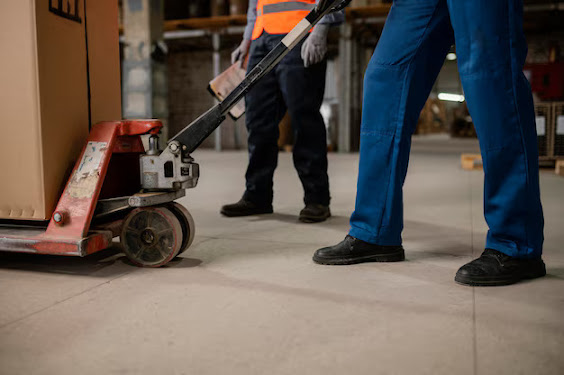
Essential instruments in production facilities, distribution centers, and warehouses are pallet jacks. These straightforward but effective tools help employees to efficiently and easily transport large pallets, hence optimizing processes. Like any tool, pallet jacks might, however, run upon issues compromising their function. Ensuring that pallet jacks run properly and avoid expensive downtime depends on regular pallet jacks maintenance & repair. The most often occurring pallet jack issues, their causes, and easy fixes for them will be covered in this blog to help your equipment work as best as it should.
A common pallet jack problem is Flat or Deflated Wheels.
Deflated or flat wheels are among the most often occurring problems with pallet jacks. This issue can make the pallet jack difficult to move, which would lower output and strain the operator.
Cause: Usually resulting from too much wear and tear, neglect, or floor punctures from trash, flat wheels are brought by by Additionally worn out by incorrect load management or pallet jack operation on uneven surfaces are the wheels.
Fix: Examining the wheels for obvious damage or punctures will help to solve flat wheels. It’s time to replace the wheel if it is cracked or quite worn down. To be sure pneumatic wheels are sufficiently inflated, routinely check their air pressure. Should your pallet jack have polyurethane or rubber wheels, be aware of wear and replace them before they go useless.
Tip: Frequent wheel cleaning and inspection for foreign objects like nails or stones that could puncture help to prevent wheel damage. Make sure your pallet jacks are also limited to usage on level, smooth surfaces.
Slow Lifting and Lowering Faulty hydraulic system
Another often occurring problem with pallet jacks is a broken hydraulic system. Should your pallet jack be rising or lowering either too slowly or not at all, the hydraulic system could be broken.
Cause: Either damaged seals, air trapped in the system, or a lack of hydraulic fluid can all lead to this issue. Hydraulic fluid might deteriorate or leak over time, which would cause inadequate pressure and poor lifting performance.
Fix: Look first at the hydraulic fluid levels. If they are low, top up the fluid using the manufacturer’s advised type. Should leaks surrounding the hydraulic pump or cylinder show, you could have to replace the seals or fix the relevant parts. Sometimes clearing air from the hydraulic system helps the system to be functionally correct.
Tip: Regular hydraulic system inspections help to replace fluid or seals at the advised intervals. Your pallet jack’s lifetime will be much increased by maintaining a clean and well-maintaining system.
Stuck or Jammed Lift Mechanism
Should the lifting mechanism of your pallet jack be jammed or stuck, it might be hazardous and frustrating. A locked mechanism can stop the fork from rising, therefore causing delays and ineffective operations.
Cause: Dirt or trash building up in the lift mechanism or components rusting or corroding could both lead to this problem. Lack of lubrication might also result in friction between the moving components, therefore producing a jam.
Fix: Look first at the lift mechanism for obvious dirt, trash, or obstacles. Excellently clean the parts, especially paying particular attention to any moving ones. Should rust or corrosion exist, apply a rust remover and re-lubricate the moving parts with a premium grease or oil intended for pallet jacks.
Tip: Especially in settings where dust or dirt is common, routinely lubricate the lift mechanism. Maintaining cleanliness and well-oiling the mechanism will help to guarantee seamless operation and aid in preventing clogs.
Unequal Load Distribution: Juggling the Pallet
Your pallet jack may not be correctly balanced if it finds it difficult to lift or carry a weight. Unequal weight distribution can tax the jack and complicate maneuverability.
Cause: When the pallet itself is damaged or when the things on it are not packed uniformly, uneven load distribution results. Should the cargo be uneven or top-heavy, the pallet jack could find it difficult to raise and move.
Fix: Make sure pallets are securely and equally stacked. To divide weight equally, always center the load on the pallet. To prevent more problems should the pallet be damaged, fix it or substitute a new one.
Tip: Teach drivers correct load distribution methods to prevent these problems. Effective load control not only increases pallet jack lifetime but also enhances safety and output.
Unresponsive Steering: Problems Maneuvering
Should the steering of your pallet jack turn unresponsive or difficult to manage, mobility will be hampered and operating risk will be increased. This is a typical problem, particularly with older or poorly kept models.
Cause: Wearing out or damaged caster wheels, a lack of lubrication in the steering mechanism, or trash that has gathered in the steering components can all lead to unresponsive steering.
Fix: Fixes at the caster wheels for wear; if needed, replace them. Using an appropriate grease or oil, lubricate the moving components and clean the steering system. Make sure the wheels move unhindered by dirt or trash and free from constraint.
Tip: Regular cleaning and lubrication of the steering components helps to avoid this problem and smooth out and ease steering.
Noisy Operation: Grinding Noises and Squeaks
Operating pallet jacks may cause squeaking or grinding noises, which would be unpleasant for operators and a clue of underlying difficulties.
Cause: Usually, noise results from worn-out components including bearings, wheels, or the lift mechanism, or from a lack of lubrication.
Fix: First lubricating the pallet jack’s moving components—including the wheels, forks, and lift mechanism—helps to correct noisy operation. Should the noise continue, check the components for damage or wear and replace any worn-out items.
Tip: To guarantee smooth functioning and lower noise, routinely check and lube the parts of the pallet jack.
Conclusion: The regular pallet Jacks maintenance and repair
Although they are essential instruments in many different sectors, pallet jacks, and industrial cardboard balers are prone to some problems that could compromise their function. Common issues, including flat wheels, malfunctioning hydraulics, jammed lift mechanisms, unequal load distribution, sluggish steering, and noisy operation, can be addressed by routine pallet jack and industrial cardboard baler maintenance & repair. Staying on top of these maintenance chores and doing timely repairs will help you to guarantee that your pallet jacks and industrial cardboard balers keep running at their best, minimize downtime, and improve general operating efficiency.






 Idea Sprout News
Leave a comment