
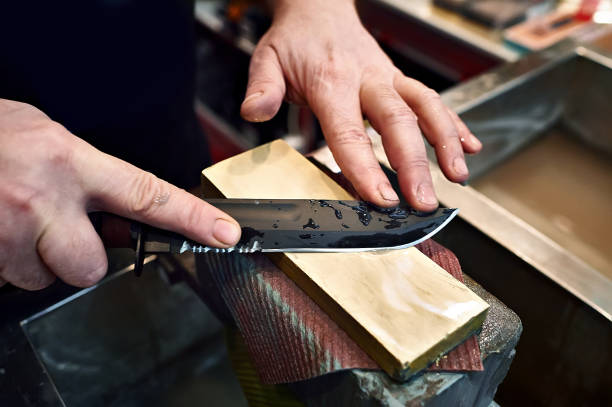
There’s something oddly satisfying about sharpening on a stone—that quiet scrape as metal meets abrasive surface, the subtle resistance fading with each pass. Whether you’re restoring a kitchen knife to its glory or bringing a chisel back to life, there’s more to it than “rub until sharp.” The magic lies in understanding grit levels.
Think of grit as the language your sharpening stone speaks. Coarse, medium, fine—each tells your blade a different story. Skip learning the language, and you might end up frustrated, wondering why your knife still smashes tomatoes instead of slicing them.
Grit 101: Why It Matters
Grit refers to the size of the abrasive particles embedded in your stone. The lower the number, the rougher the stone. A 200–400 grit? That’s like sending your blade to boot camp—it’s aggressive, removing metal fast and fixing big chips. Jump to 1,000–2,000 grit, and you’re refining the edge, smoothing away the scars left by the coarse work. Hit the 6,000–8,000 range, and you’re basically polishing the edge until it gleams like a mirror.
The science here is simple but fascinating. Bigger grit particles cut deeper scratches into the steel. As you move up in grit, the scratches get smaller and shallower, producing a sharper, smoother edge. Skip too many steps between grits, and you’ll be stuck trying to polish a mountain range.
Choosing the Right Grit for the Job
Here’s where a lot of people mess up: using the wrong grit for the task.
- Dull or damaged edge? Start coarse (220–400 grit). Don’t baby it—the blade needs reshaping.
- Regular maintenance? Medium grit (800–1,200) is your sweet spot.
- Razor finish? High grit (3,000–8,000) for that paper-slicing sharpness.
And yes, you can use a combination stone to save money and space. One side coarse, the other fine—it’s like having a gym and a spa in one block.
Pressure, Angle, and Patience (The Unwritten Rules)
Grit is important, but it’s not the whole picture. Sharpening is a dance between pressure, angle, and time. Keep your angle consistent—most knives like 15–20 degrees. Apply more pressure in the early stages, lighten up as you move to finer grits. Rushing it? Bad idea. The steel needs time to respond.
I once thought I could skip the fine grit stage “just this once” on my chef’s knife. Big mistake. Sure, it looked sharp, but the first time I diced onions, the blade tore instead of slicing. Felt like cutting with a spoon. Lesson learned.
Wet vs. Dry Sharpening Stones
Water stones, oil stones, diamond stones—each has its quirks. Water stones cut faster but wear down quicker. Oil stones are slower but last longer. Diamond stones? They’re the bulldozers of the sharpening world—fast, flat, and tough.
If you’re new, I’d say start with a water stone. It’s forgiving, affordable, and you get that meditative splash of water as you work.
Common Grit Myths
Let’s bust a couple:
- “Higher grit is always better.” Nope. You can over-polish an edge, making it too smooth and prone to slipping instead of biting.
- “One stone does it all.” Only if you enjoy frustration. Multi-grit is the way to go.
- “You need to sharpen every week.” Not true—hone often, sharpen when needed.
Sharpening as a Skill, Not a Chore
Here’s the thing: sharpening isn’t just maintenance—it’s craftsmanship. The sound, the feel, the result… it’s addictive. And once you understand grit levels, you start looking at your tools differently. They’re not just blades; they’re partners in your work, whether in the kitchen, workshop, or garage.
So the next time you pick up a stone, remember—it’s not just about sharpness. It’s about control, precision, and yes, a little bit of pride in doing it yourself. And hey, when you mix that knowledge with other diy home improvement efficiency hacks, you’ll find that sharpening isn’t just a skill—it’s an edge in more ways than one.






 Idea Sprout News
Leave a comment